Introduction
Hair loss is one of the most common concerns walking into a dermatology or cosmetic surgery clinic today, affecting both men and women across age groups. Whether it starts as a receding hairline or gradual thinning at the crown, the question almost every patient asks is the same: should I go for medicine, or is a hair transplant the better long-term choice? At Kosmo Plus Hospital, Dr. Ankit Shah and team help patients navigate this decision every week — and the honest answer depends on the cause, stage, and extent of your hair loss.
Understanding Why Hair Loss Happens
Before choosing a treatment, it helps to understand the cause. Genetics (androgenetic alopecia, or male/female pattern baldness) is the most common reason, but hormonal changes, chronic stress, nutritional deficiencies, thyroid issues, and certain medications can also trigger hair thinning. Identifying the root cause is the first step, because it directly influences whether medicine alone can help, or whether surgical restoration is needed.
How Medicine Works for Hair Loss
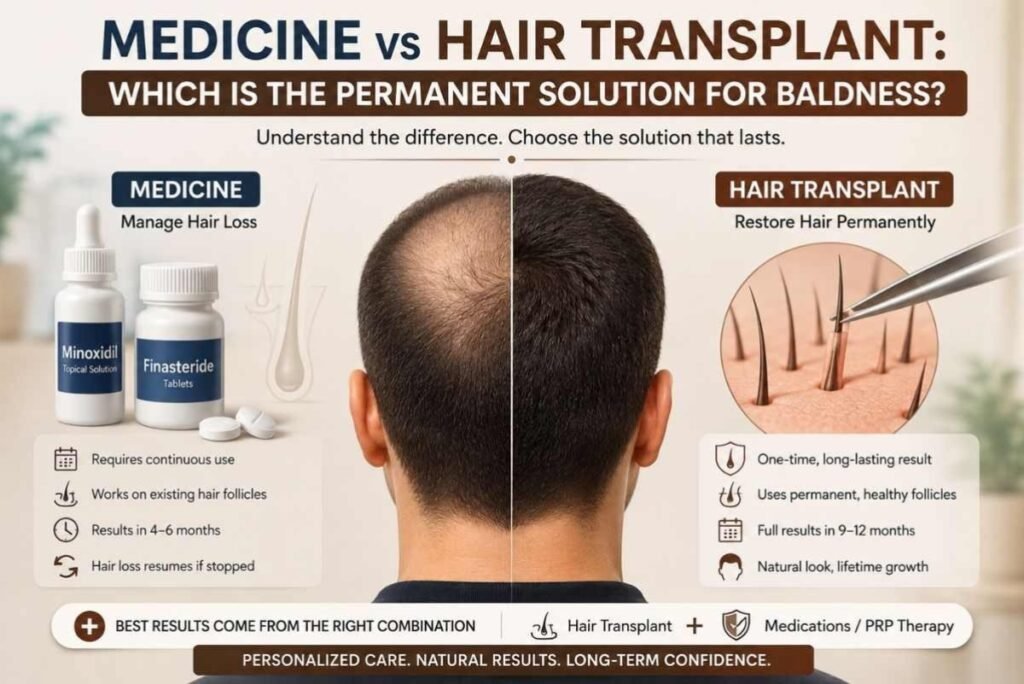
Medications like Minoxidil (topical) and Finasteride (oral) are the two most widely prescribed treatments for pattern baldness. Minoxidil works by improving blood flow to hair follicles, encouraging thicker, longer growth in the treated area. Finasteride works differently – it blocks DHT (dihydrotestosterone), the hormone primarily responsible for shrinking hair follicles in genetic baldness.
These medicines can be genuinely effective, especially in the early stages of hair loss, and many patients see visible improvement within 4 to 6 months of consistent use. However, there’s an important catch: medicine manages hair loss; it doesn’t cure it. Results depend on continued use – stop the medication, and hair loss typically resumes within months. For patients with advanced baldness or completely bald patches, medicine alone usually isn’t enough to restore visible density, since it works on follicles that are still active, not ones that have already stopped functioning.
How a Hair Transplant Works
A hair transplant is a surgical procedure that physically moves healthy, active hair follicles from a donor area (usually the back or sides of the scalp, which are genetically resistant to balding) to thinning or bald areas. At Kosmo Plus, this is done through two established techniques:
FUE (Follicular Unit Extraction): Individual follicles are extracted and implanted one by one. It’s minimally invasive, leaves no linear scar, and has a quicker recovery – making it a popular choice for most patients today.
FUT (Follicular Unit Transplantation / Strip Method): A thin strip of scalp is removed to harvest a larger number of grafts in one sitting, making it suitable for patients with more extensive hair loss. The resulting scar is thin and easily hidden by surrounding hair.
Many patients also combine their transplant with PRP (Platelet-Rich Plasma) therapy, which uses the patient’s own platelets to strengthen existing hair and support the growth of newly transplanted follicles.
Because transplanted follicles are taken from a balding-resistant zone, they continue growing naturally in their new location for a lifetime – which is why hair transplant is widely considered the truly permanent solution, unlike medicine, which requires ongoing use to maintain results.
Medicine vs Hair Transplant: The Real Comparison
Factor | Medicine | Hair Transplant |
Best suited for | Early-stage thinning | Moderate to advanced baldness |
Permanence | Requires continuous use | One-time, long-lasting result |
Visible results | 4–6 months, gradual | 3–6 months growth, full results in 9–12 months |
Recovery | None | 2–3 days for light activity |
Maintenance | Ongoing | Minimal, mainly scalp care |
So, Which One Should You Choose?
If you’re noticing early thinning and still have active follicles in the affected area, medicine can be a reasonable first step to slow down further loss. But if you have a receded hairline, visible bald patches, or have already tried medication without satisfactory results, a hair transplant offers something medicine simply cannot: a permanent, one-time restoration that doesn’t depend on daily pills or lotions.
In many cases, the two aren’t even competitors – Dr. Ankit Shah often recommends a combined approach at Kosmo Plus, using a hair transplant to restore density in bald areas while continuing light medical treatment or PRP therapy to protect and strengthen the surrounding natural hair. This combination tends to give patients the most stable, natural-looking, long-term results.
Final Thoughts
There’s no single “better” option for everyone – it genuinely depends on your stage of hair loss, goals, and how much of a long-term commitment you’re willing to make. Medicine can slow the clock, but a hair transplant, done right, resets it. The best way to know which path suits you is a proper scalp evaluation.
If you’re exploring your options, Dr. Ankit Shah and the team at Kosmo Plus Hospital, Ahmedabad, offer personalized consultations to help you understand what’s actually happening with your hair — and design a treatment plan that fits your specific case, not a one-size-fits-all approach.